Synchronization Challenges in Real-Time Group Decision Making Across Internet-Delivered Interactive Modules
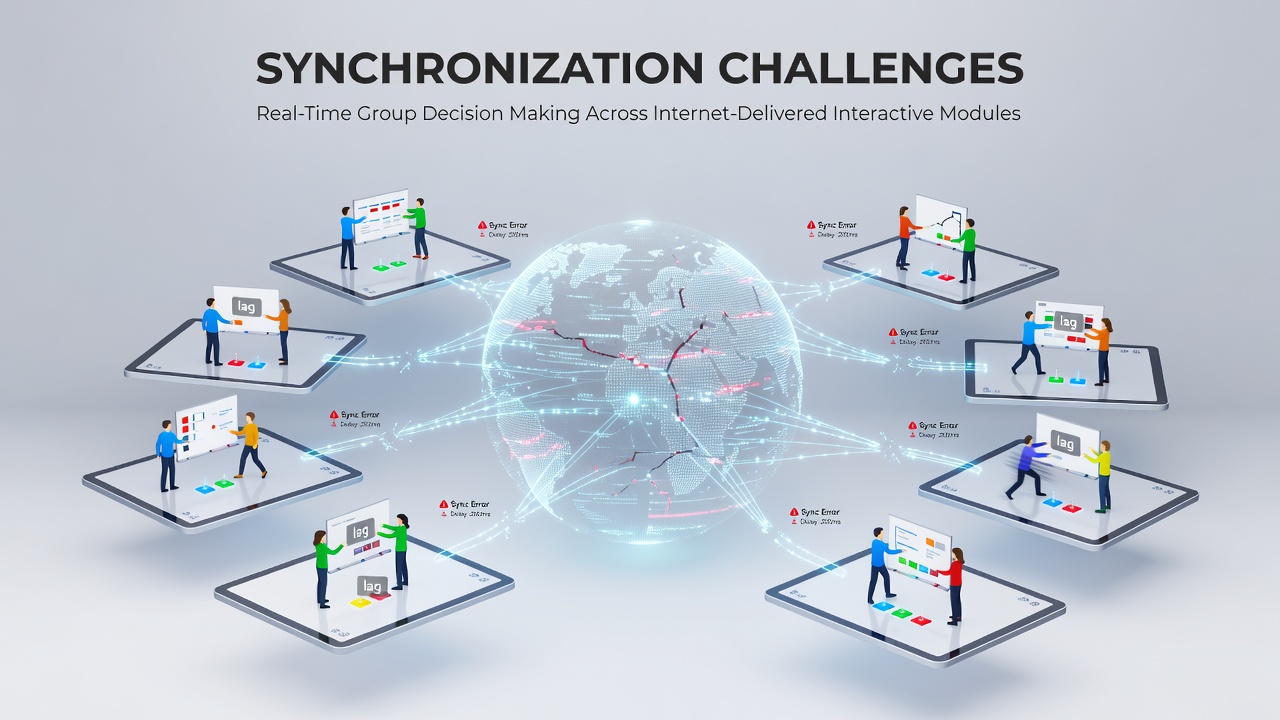
Internet-delivered interactive modules now support group decision processes in fields ranging from corporate strategy sessions to educational simulations, yet maintaining consistent state across participants introduces persistent technical hurdles. Network variability creates timing discrepancies that disrupt shared views of data, options, and outcomes during live interactions.
Latency differences between users can reach several hundred milliseconds depending on geographic distance and connection quality, which forces systems to reconcile inputs that arrive out of sequence. Observers note that protocols such as WebSockets and WebRTC attempt to minimize these gaps, while underlying packet loss still produces visible desynchronization when multiple participants submit choices simultaneously.
Core Technical Barriers in Distributed Coordination
Clock skew among client devices compounds the problem because each module operates on its own local timer unless a centralized reference is enforced. Researchers have documented cases where even small offsets of 50 milliseconds lead to conflicting resolution of simultaneous votes or preference rankings. Systems therefore rely on logical timestamps or vector clocks to order events without depending solely on physical clocks.
Consistency models add another layer of complexity. Eventual consistency allows faster responsiveness but risks temporary divergence where one participant sees an option as selected while another still views it as pending. Strong consistency guarantees identical views yet increases round-trip times, particularly when modules span multiple continents. Studies conducted by institutions in North America and Europe demonstrate that hybrid approaches using conflict-free replicated data types (CRDTs) reduce visible inconsistencies without full locking mechanisms.
Impact on Decision Accuracy and Participant Experience
When synchronization falters, groups encounter situations where a decision appears finalized on one screen but remains open on another, prompting repeated submissions or confusion over final tallies. Data collected from large-scale collaborative platforms shows measurable drops in agreement rates once average latency exceeds 150 milliseconds. Those who design these modules often implement prediction algorithms that forecast likely inputs and pre-render probable states, though prediction errors become noticeable during rapid shifts in group consensus.

Bandwidth constraints further limit the frequency of state updates. Modules handling detailed visual representations of decision trees or scenario simulations must compress payloads, which occasionally discards fine-grained timing information needed for precise ordering. Reports from the National Institute of Standards and Technology highlight that adaptive bitrate strategies can preserve ordering metadata even under constrained conditions, yet these techniques require continuous monitoring of participant connection profiles.
Approaches Employed by Current Implementations
Developers integrate operational transformation techniques originally refined in collaborative document editors, adapting them to decision-specific data structures such as ranked lists or weighted scoring matrices. Australian research groups have published findings on extending these methods to support voting rounds where partial results must remain hidden until all inputs synchronize. Server-side reconciliation engines then apply predefined rules for tie-breaking or preference aggregation once all messages arrive within a defined window.
Edge computing deployments place processing nodes closer to clusters of users, shrinking the physical distance packets travel and thereby lowering variance in arrival times. European regulatory frameworks encourage such distributed architectures for public sector applications to meet accessibility standards across member states. As of June 2026, several municipal planning platforms have adopted this model, reporting reduced incidence of out-of-order submissions during live consultation periods.
Future Directions and Ongoing Research
Quantum-resistant timestamping and improved global time distribution services continue to attract attention from academic consortia seeking to eliminate residual skew. Machine learning models trained on historical latency patterns now assist in dynamic adjustment of update intervals, allowing modules to allocate more frequent synchronization bursts during high-stakes decision phases. Industry associations tracking web standards track these developments closely because browser APIs directly influence what client-side guarantees remain feasible.
Security considerations intersect with synchronization requirements because authenticated ordering prevents malicious reordering attacks that could alter perceived consensus. Implementations therefore combine cryptographic signing of events with the same logical clocks used for consistency, ensuring both integrity and temporal correctness without introducing prohibitive overhead.
Conclusion
Internet-delivered interactive modules for group decisions depend on careful orchestration of timing, ordering, and state propagation to function reliably. Continued advances in distributed systems research, combined with infrastructure improvements, steadily narrow the gaps that latency and skew create. Organizations deploying these tools benefit from ongoing measurement of synchronization metrics to maintain decision integrity across diverse participant networks.